To incorporate an SRL or SA in Belgium, your notary asks for a financial plan covering the first two years. Banks ask for the same projections with a credit application. Most founders either pay an accountant €500 to €1,500 to produce one, or spend evenings in a form-based tool that charges per file and expires their work after a few months.
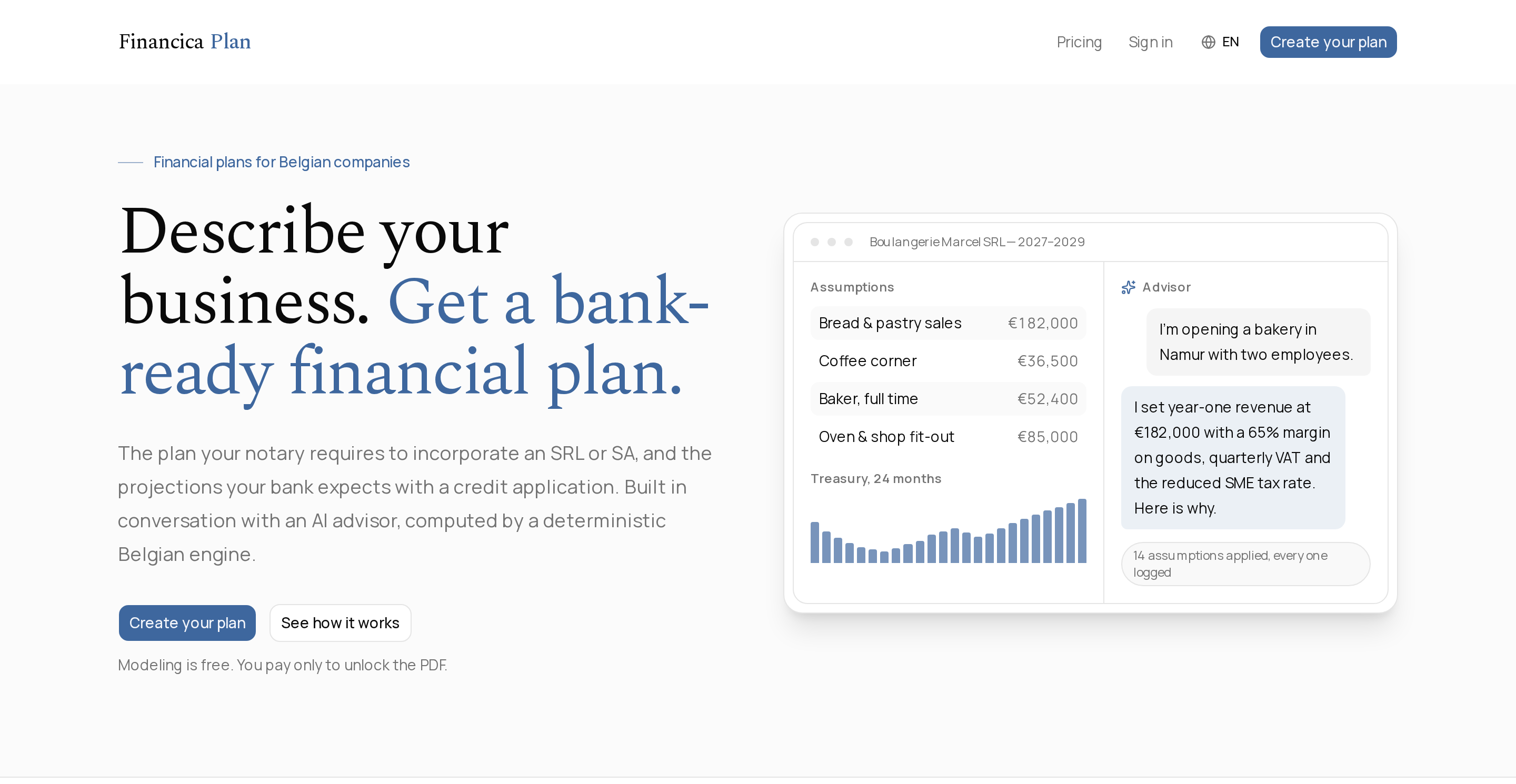
Financica Plan is a third option: a financial plan builder that runs on your existing Financica account. You describe your business to an AI advisor, which builds the plan with you. An engine computes every number. Modeling is free; you pay €15 once, when you want the clean PDF.
How building a plan works
Sign in with your Financica account (same organizations, same session) and create a plan. You can fill in the assumptions yourself: revenue and cost lines, personnel, investments, loans, capital. Or you can tell the advisor what you are planning in plain language, in English, French or Dutch, and let it do the structuring.
The advisor edits the plan through the same audited operations the editing UI uses. A few things worth noting:
- Every change it makes is logged in the Activity tab, alongside edits made by hand, with the actor recorded. If you want a safety copy before letting it restructure something, duplicate the scenario first; duplicates are free.
- Anything destructive (deleting a scenario or a plan, spending credits) pauses and asks for your approval first.
- You can ask it questions as well as give it instructions: "Is my plan bankable?", "What salary can I pay myself?", "Stress-test a three-month revenue delay."
Plans and advisor conversations belong to your organization, like the rest of your Financica data, and are not used to train models.
What the engine models
The advisor only sets assumptions. Every figure comes from a deterministic engine that models Belgian rules explicitly:
- VAT under the franchise, normal (quarterly or monthly) or exempt regime, with filing settlement in the treasury and a warning when franchise revenue exceeds the €25,000 ceiling.
- Corporate tax at 25%, with the reduced SME rate of 20% on the first €100,000. Eligibility for the reduced rate is a setting you control, and the engine cross-checks it against the plan's own numbers: when the projected director remuneration is below the statutory minimum, it warns rather than silently assuming the benefit. The 9% surcharge for insufficient advance payments is modeled too, as is the exemption for a company's first three exercises.
- Depreciation linear pro rata temporis, and loans amortizing or bullet, with full repayment schedules.
- A monthly treasury that respects payment delays, quarterly social contributions for a self-employed director, and an optional automatic overdraft.
- Projected income statements, balance sheets, ratios, break-even, and the opening balance sheet.
Presentation follows the Belgian statutory scheme. One detail worth checking: a self-employed director's remuneration books under account 618, in services et biens divers, not under personnel costs. The same PCMN classification drives both Financica products, so a plan lines up with real bookkeeping later.
The engine makes some simplifications, and the PDF says so: inventory is not modeled (goods count as consumed when purchased), and VAT periods align on plan months rather than calendar filing dates.
What the notary reads
The financial plan is not paperwork. If the company fails in its first three years, the plan is what a court examines when it weighs founder liability, which is why the Companies Code prescribes its content. The report covers the sections article 5:4 expects: a description of the activity, the sources of financing, an opening balance sheet, projected income statements and balance sheets over at least two years, a monthly budget of income and expenses, and a methodology page stating every assumption and simplification, so the person reading it knows exactly what they are looking at.
You can read the full report as a watermarked preview before paying anything, and share a read-only link with your accountant for review. Unlocking removes the watermark from both the PDF and the share link.
If you keep your books in Financica
Plans stay useful after incorporation. Once a plan's first months are in the past, a Plan vs actuals tab lines up its projections against your real Financica bookkeeping, month by month, per category. You see where the projections held and where they didn't.
What it costs
- Building, editing, scenarios and the on-screen results are free, and plans never expire. The watermarked PDF preview is free too.
- The AI advisor costs 1 credit per message you send. The advisor's own replies, tool work and approval round-trips cost nothing.
- Unlocking a plan's clean PDF and share link costs 15 credits, once per plan, re-exportable forever afterwards.
- 1 credit is €1 (excl. VAT). Every new organization starts with 10 free credits, and packs start at €30, with bonus credits on the €150 and €300 packs.
A worked example: building a full plan in conversation takes a few dozen advisor messages. With the 10 free credits, a single €30 pack typically covers the whole thing, PDF unlock included. Filling the assumptions in by hand needs only the 15-credit unlock, which with the free credits still means one €30 pack, and leaves you credits for the advisor afterwards.
Financica Plan is live at plan.financica.app, in English, French and Dutch. It also appears under Tools in the site footer.